
Introduction
The neotropical genus Witheringia L’Her. encompasses about 20 species. It lies within the tribe Physalideae, which includes other small to medium primarily neotropical genera including Iochroma and Deprea as well as the large genus Physalis. The genus Cuatresia was formerly thought to be closely related to Witheringia because they share unequal geminate leaves and often truncate calyces. However, while Cuatresia also lies within the Physalidae, it is not particularly close to Witheringia, belonging to the subtribe Withaninae rather than the subtribe Physalinae.
The genus Witheringia is still not well understood, with active work required to describe new species and resolve ambiguities. Following recent molecular work (Stone et al. 2024), the circumscription of the genus is relatively stable. The previously recognized genus Brachistus, differentiated from by its deeply lobed and often accrescent calyx, has now been subsumed into Witheringia.
Key features
Witheringia is characterized by unequal geminate leaves, axillary inflorescences with numerous flowers, corolla lobes usually longer than the tube, longitudinally dehiscent anthers, and orange to red fleshy berries.
Distribution & ecology
The geographic range of Witheringia extends from Mexico and the Antilles to Bolivia and Brazil. The type species (W. solanacea) is very widespread, apparently occupying the entire range of the genus. In contrast, numerous species of Witheringia have very narrow geographic ranges, especially in Costa Rica and Colombia. Witheringia species can be locally common at low to mid-elevations in forest understory and along relatively undisturbed roadsides and agricultural settings.
Description
Witheringia L’Her., Sert. Angl. 1: 19 . t. 1 (1788)
Type species: W. solanacea L’Hér.
Herbs, shrubs, or small trees 0.5-6 m tall, glabrous or pubescent with simple or branched, glandular or eglandular hairs; prickles absent. Leaves petiolate, simple, entire or shallowly lobed, solitary or usually paired and unequal in size, membranaceous to subcoriaceous. Inflorescences axillary, sessile or pedunculate. Flowers 4- or 5- merous, radially symmetrical. Calyx campanulate, truncate to shallowly or deeply 4- or 5-lobed, accrescent or not, subtending to nearly completely enclosing the fruit. Corolla white, greenish, yellowish, or purplish, often with greenish spots at base, stellate, campanulate or urceolate, 4- or 5-lobed, generally with a ring of pubescence internally near the level of filament insertion. Stamens 4-5, equal, exserted or included; filaments usually shorter than the anthers, inserted near or above middle of corolla tube, pubescent; anthers basifixed, often apiculate, dehiscing by longitudinal slits. Ovary 2-carpellate, glabrous or pubescent, with a basal nectar disk; style cylindrical or umbrella-shaped, exserted or included; stigma capitate. Fruit a juicy berry. Seeds many per fruit, flattened; embryo curved.
Images
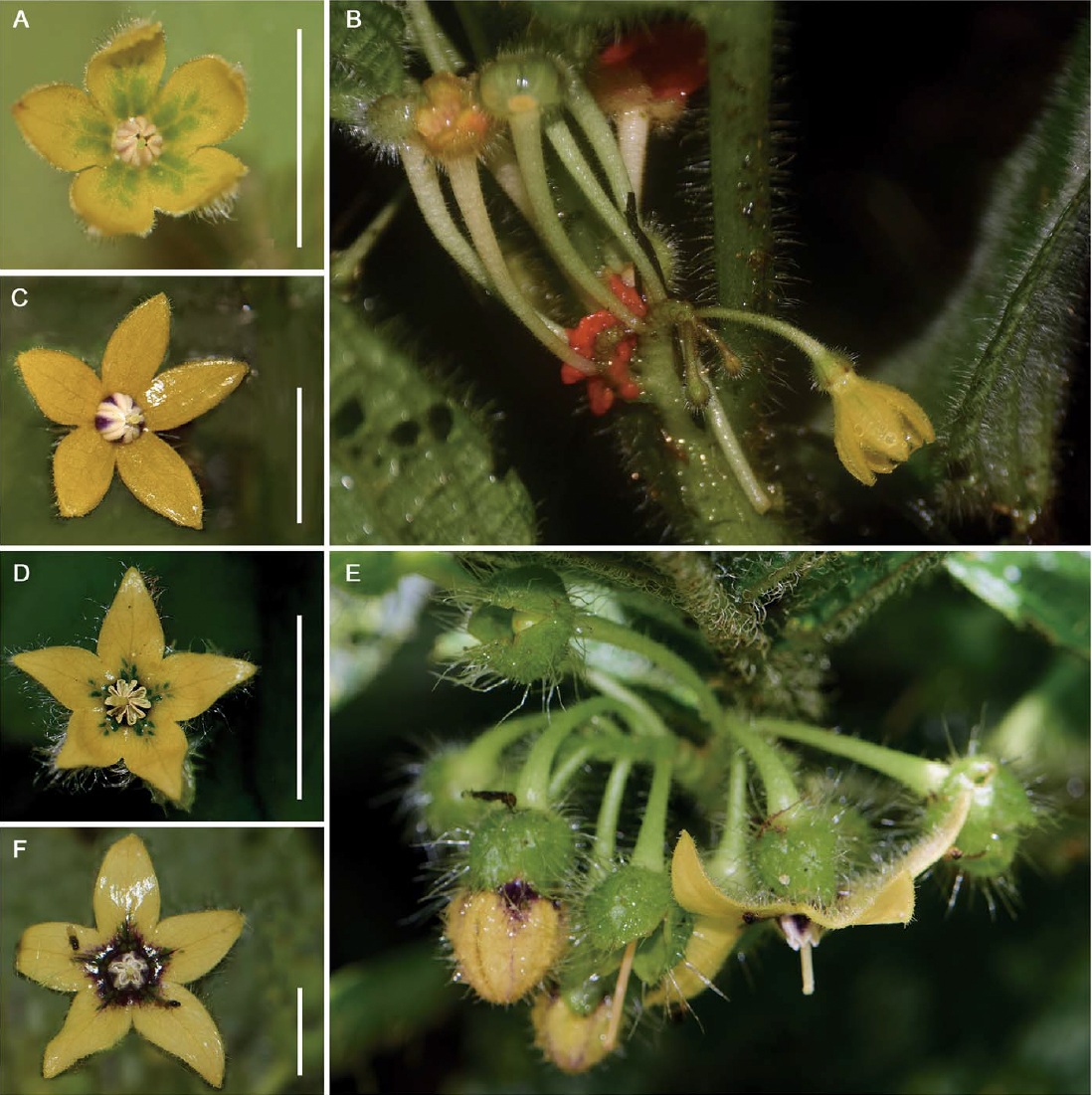
Photo plate of Witheringia correana from Stone et al. (2024): A-B. Stone & Flores 1543; C. Stone & Flores 1545; D-E. cf. Bohs 2512; F. Stone & Flores 1548. Photos by J. Flores.
Line drawing of Witheringia knappiae from original description (as Brachistus knappiae).
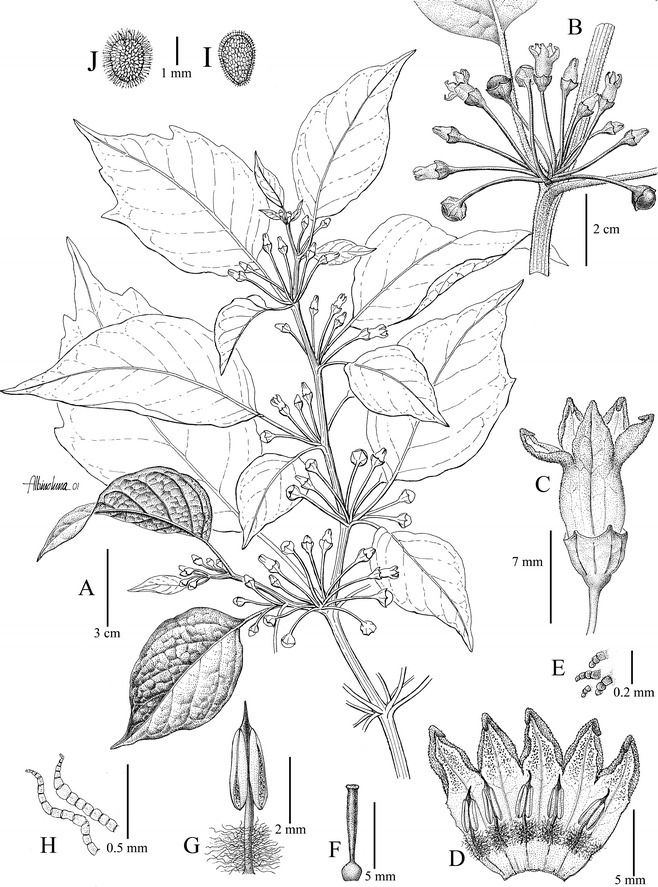
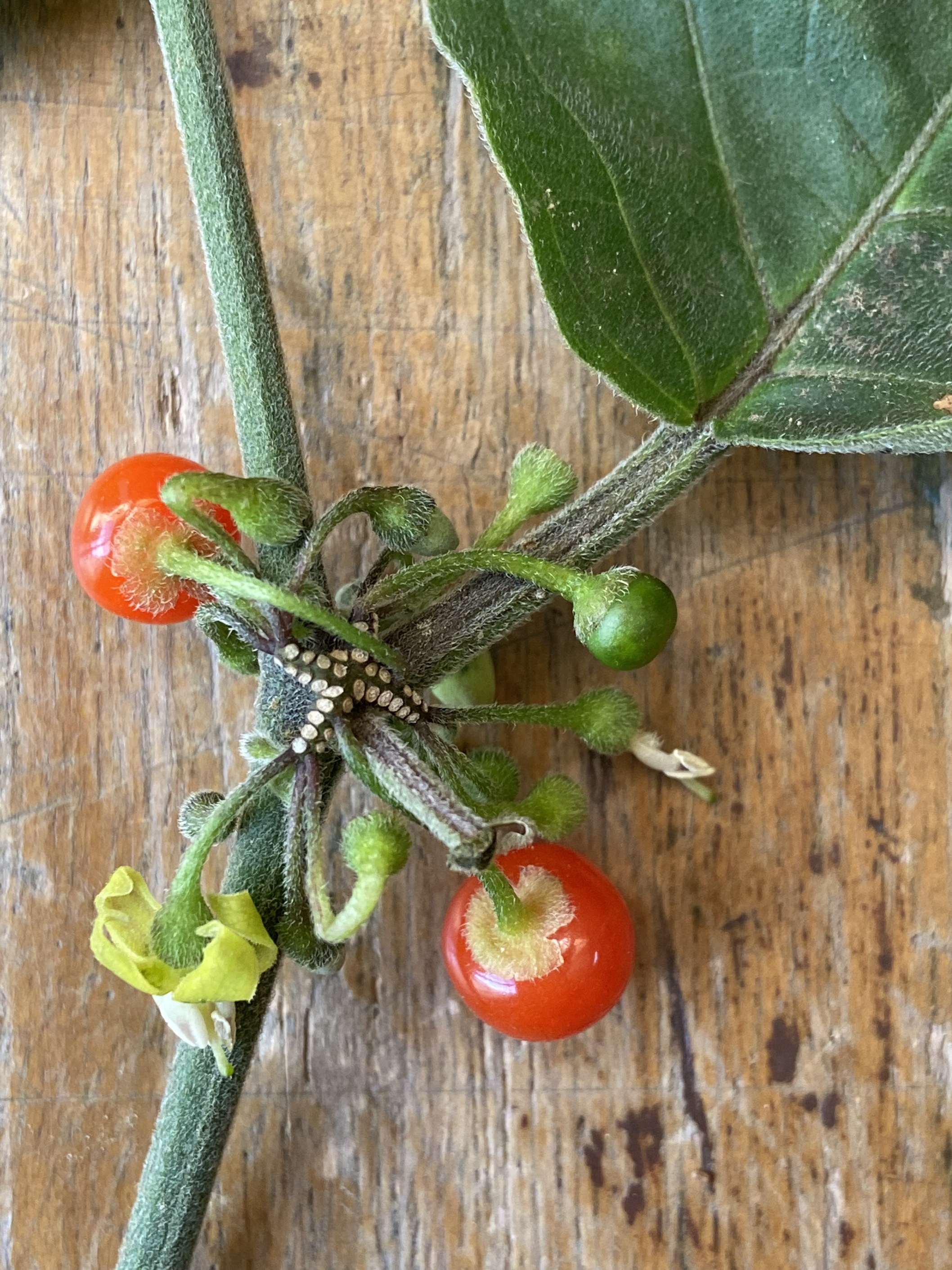
Photo of Witheringia solanacea based on Sierra 213. Photo by G.Sierra.
To learn more
Bohs, L. (2015) Solanaceae. Pp. 205-336 in Manual de Plantas de Costa Rica, vol. VIII, eds. B.E.Hammel, M.H.Grayum, C.Herrera & N.Zamora. Monographs in Systematic Botany from the Missouri Botanical Garden 131. St. Louis, MO: Missouri Botanical Garden Press.
Hunziker, A.T. (1969) Estudios sobre Solanaceae. V. Contribución al conocimiento de Capsicum y generos afines (Witheringia, Acnistus, Athenaea, etc.). Primera parte. Kurtziana 5: 101-179.
Stone, J.L., Flores, J. & Bohs, L. (2024) Phylogenetic relationships of Brachistus and Witheringia (Solanaceae). Syst. Bot. 49(2): 496–506.
List of species
Below is an alphabetical list of all accepted species following the Solanaceae TEN WFO taxonomy. Species in bold are firmly accepted; species not in bold need further research and their status as accepted is less certain. The current taxonomy is also accessible by Browse or Advanced Search.
| Genus | Species description | Occurrence data |
|---|---|---|
| Witheringia affinis (C.V.Morton) Hunz. | WFO | GBIF |
| Witheringia asterotricha (Standl.) Hunz. | WFO | GBIF |
| Witheringia bristaniana D’Arcy | WFO | GBIF |
| Witheringia coccoloboides (Dammer) Hunz. | WFO | GBIF |
| Witheringia correana D’Arcy | WFO | GBIF |
| Witheringia fuscoviolacea (Cufod.) Hunz. | WFO | GBIF |
| Witheringia hunzikeri D’Arcy | WFO | GBIF |
| Witheringia killipiana Hunz. | WFO | GBIF |
| Witheringia knappiae (Mont.-Castro & Sousa-Peña) Bohs | WFO | GBIF |
| Witheringia macrantha (Standl. & C.V.Morton) Hunz. | WFO | GBIF |
| Witheringia maculata (Standl. & C.V.Morton) Hunz. | WFO | GBIF |
| Witheringia meiantha (Donn.Sm.) Hunz. | WFO | GBIF |
| Witheringia mexicana (B.L.Rob) Hunz. | WFO | GBIF |
| Witheringia mortonii Hunz. | WFO | GBIF |
| Witheringia nelsonii (Fernald) Hunz. | WFO | GBIF |
| Witheringia solanacea L’Hér. | WFO | GBIF |
| Witheringia stellata (Greenm.) Hunz. | WFO | GBIF |
| Witheringia stramoniifolia Kunth | WFO | GBIF |