
Introduction
A genus of 14 species The plants are commonly called Thorn Apples in english, and the attractively large, tubular flowers are known as “Angel’s trumpets” or “moon-flowers” by some and are cultivated in gardens around the world. Some species have a long history of use as drug plants. The delirium induced by the tropane alkaloids has been the neurophysiological basis of its employment; more than 30 compounds from the tropane group have been reported in Datura. Plastid sequence data showed some support for recognising D. kymatocarpa and D. reburra as two distinct species apart from D. discolor (Bye & Sosa 2013). Datura reburra has regularly dehiscing capsules that point upwards, while D. discolor and D. kymatocarpa have pendant fruits.
Key features
Distinct features include solitary erect flowers with the elongated tubular 5-lobed calyces that appear more or less sessile, infundibuliform corollas with cuspidate lobes, long slender glabrous filaments, and capsular valvate fruits subtended by the cupular remains of the calyx. Flowers in the genus Datura are similar to Brugmansia but the two genera differ in many features: Datura species are herbs and shrubs with upright flowers and capsular fruits, while Brugmansia species are trees with pendant flowers and berries. Most Datura fruits are spiny. Most species have fruits pointing upwards (D. ferox, D. quercifolia, and D. stramonium), but others have pendant fruits (D. arenicola, D. discolor).
Distribution & ecology
Species of the genus are found across tropical and warm-temperate areas of the World, but native to southern USA and Mexico. Most species are found between 0-1700 m elevation, growing in dry, open and disturbed habitats, only one is found in moist, semi-aquatic areas (D. ceratocaula).
Description
Datura L., Sp. Pl. 1: 179 (1753)
Type species: D. stramonium L.
Annual herbs or short-lived perennials (0.2) 0.5-1.2 (2) m high, usually rather malodorous, dichotomously branched, glabrous, glabrescent or pubescent, the indument with various types of trichomes (erect, appressed, retrorse, antrorse, conical, simple, non-glandular or glandular) rather dense or very dense in the immature foliage, pedicels and calyces, the mature parts with sparse to absent trichomes or sometimes remaining pubescent; stems solid or exceptionally hollow (D. ceratocaula Ort.); mature leaf blades ovate to ovate-lanceolate, margin entire, repand, deeply or shallowly sinuate-dentate or lobed, (5) 8-18 (30) cm long, base usually unequal or subequal, apex acute, petioles (2) 5-10 (16) cm long. Ramification predominantly dichasial, with erect or oblique flowers in the branch forks; flowers shortly pedicellate, pedicels (5) 7-15 (25) mm long, calyx cylindric, 2.5-14 (16) cm long, shortly (3) 5 (6) lobed, or narrowly toothed, lobes or teeth triangular, equal or unequal, acute to acuminate, 6-12 mm long, sometimes longer (13-35 mm long), on occasions incompletely separated, by exception (D. ceratocaula) split along one side giving it a spathe-like appearance, circumscissile after anthesis near the base, leaving an annular basal remnant; corolla opening in the evening, broadly funnelform or trumpet-shaped, by exception double or triple, uniform white, lavender or purple, of two sizes according to the species: 4-6 (9.5) cm long or (8) 15-21 cm long, limb five-lobed, true lobes short and distinctly cuspidate (in some species a secondary not acuminate lobe appears between the true ones causing the outline of the limb to look 10-lobed); stamens usually included, filaments adnate to the lower half of the corolla, glabrous except for the portion adnate to the corolla covered with minute trichomes, anthers linear-ellipsoid, basifixed, with latrorse dehiscence, of two sizes according to the species: 2-5 mm long or 5-12 (15) mm long, the dehiscent margins with very long filamentous trichomes; ovary conic, partially inferior, usually tetralocular in its lower half by the formation of false septa, decorated in general with a variable number of small fleshy spines which, on occasions, become rigid and enlarged in the fruit, style submesogynous, stigma bilobed, wet and papillate; nectary invaginated-pelviform with rather irregular slight ondulations, clearly separated from the ovary by the invagination. Excepting D. ceratocaula with smooth, indehiscent berries, the rest of the species has ovoid, ellipsoid, or globose capsules, erect or deflexed, tetralocular, the dehiscence septifrage by (2) 4 valves, sometimes irregular; in all the species the fruits subtended by the persistent, discoidal, reflexed, accrescent calyx remnant; pericarp usually puberulent, covered with spines (equal, slender and numerous, up to 200; or dissimilar, sharp and fewer, ca. 50) 0.5-3.2 cm long, or with weak pubescent bristles, or with many short, blunt tubercles. Seeds (25) 150-300 (500) per fruit, discoidal or reniform, compressed (2.5) 4-5 (6) mm long, without elaiosomes or with white or yellowish ones, these persistent or sometimes caducous, 1-2.5 mm long; testa usually black, yellow or brown, reticulate-foveate, verrucose, finely pitted, furrowed or ridged; embryo annular with a peculiar hook or small curvature next to the apex of the cotyledons; endosperm “ab initio” cellular, afterwards, its cells show very thick and hard cell walls, lacking starch, but with lipid vesicles and rich in protein bodies (containing one protein crystalloid and one or more globoid crystals). x= 12.
Images
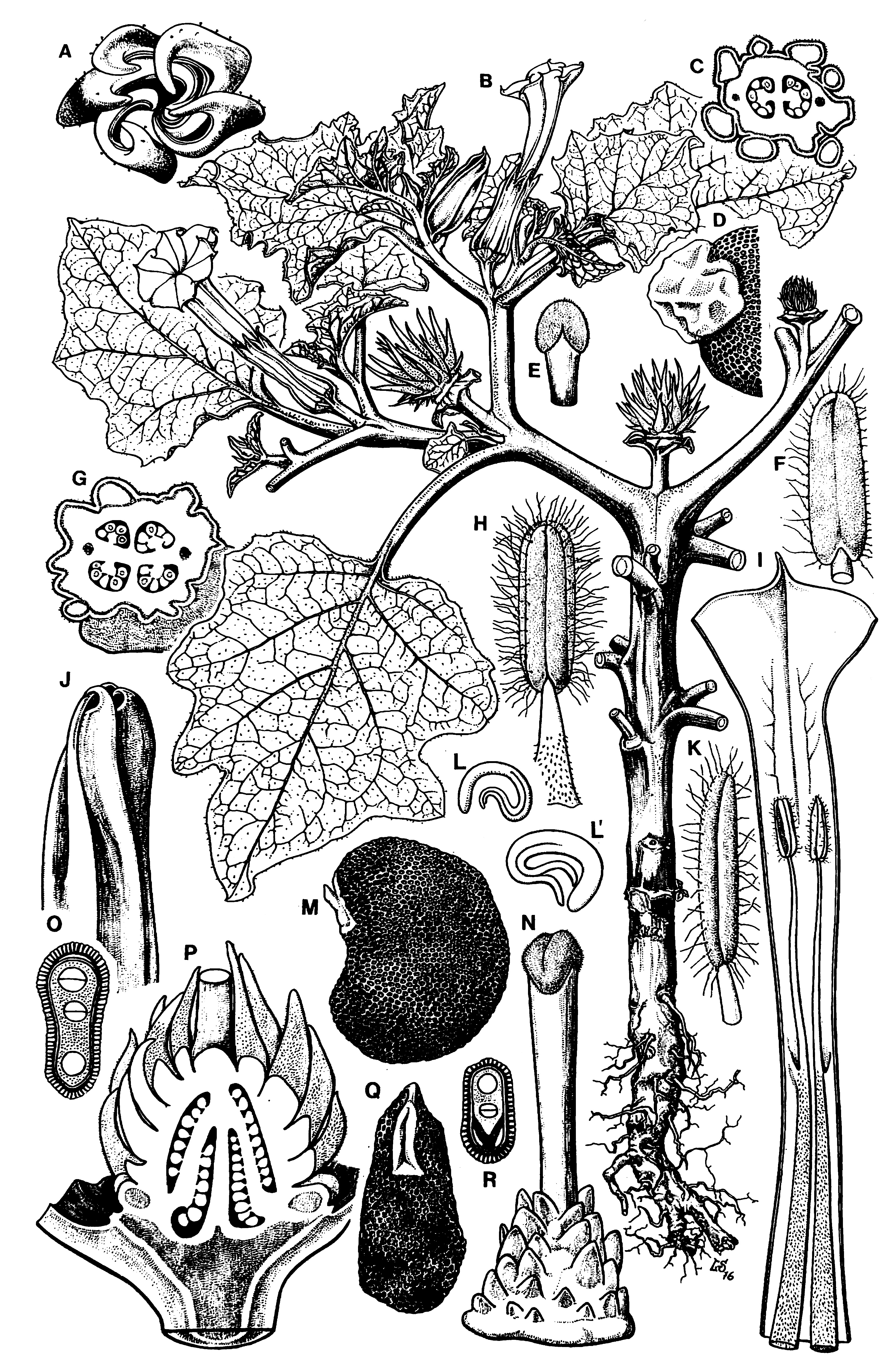
Datura ferox illustrated by L. Sánchez in Hunziker (2001) Genera Solanacearum.
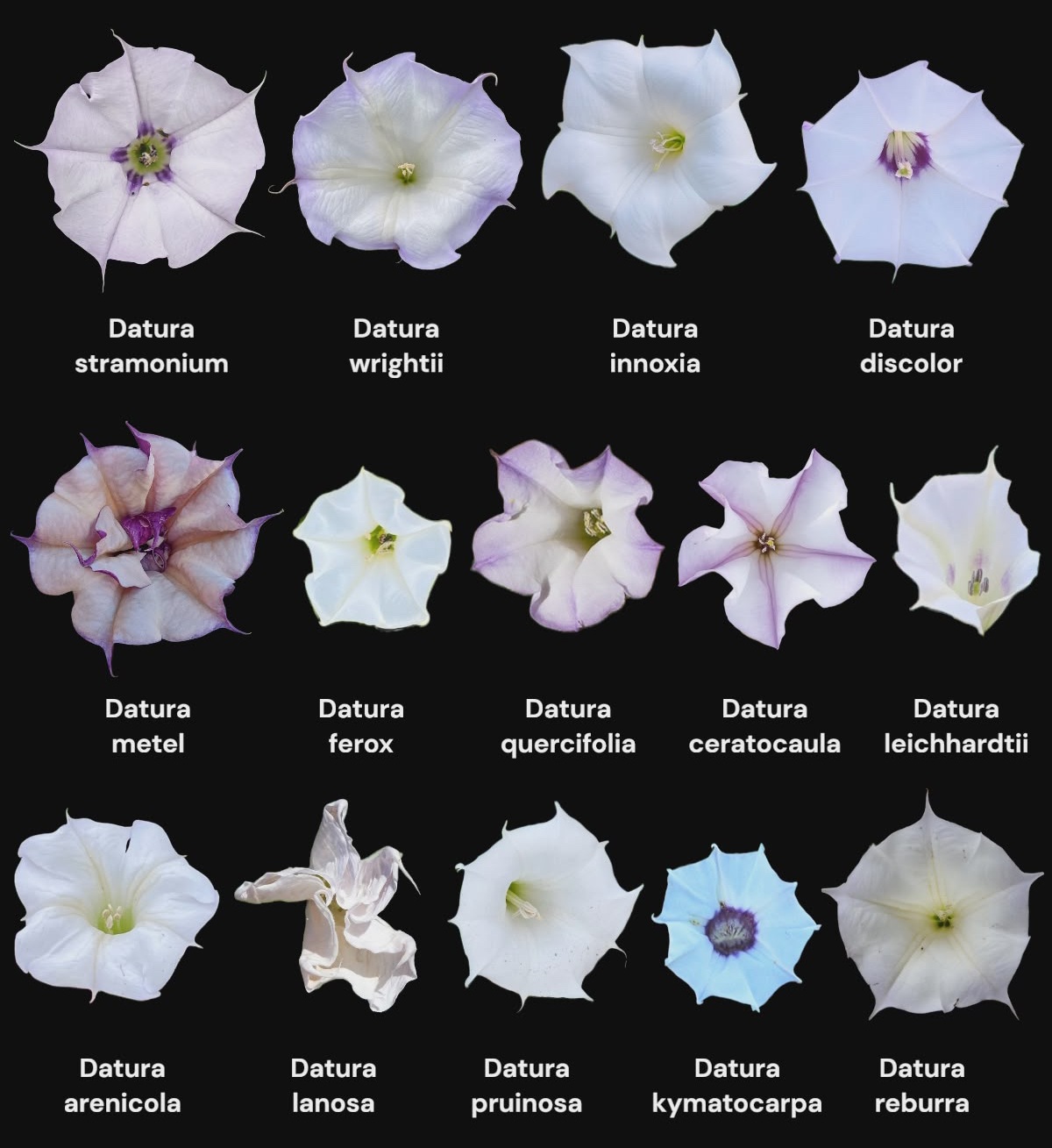
 A photoplate of all species of Datura by Gabe Gallagher.
To learn more
Avery, A.G., Satina, S. & Rietsema, J. (1959) Blakeslee: The genus Datura. New York: Ronald Press Co.
Bye, R. & Sosa, V. (2013) Molecular phylogeny of the Jimsonweed genus Datura (Solanaceae). Systematic Botany 38: 818-829.
Hammer, K., Romeike, A. & Tittel, C. (1983) Vorarbeiten zur monographischen Darstellung von wildpflanzensortimenten: Datura L., sectiones Dutra Bernh, Ceratocaulis Bernh. et Datura. Die Kulturpflanze 31: 13-75.
Martinez, M., Vargas-Ponce, O., Rodriguez, A., Chiang, F. & Ocegueda S. (2017) Solanaceae family in Mexico. Botanical Sciences 95(1): 131-145. DOI: 10.17129/botsci.658
Purdie, R.W., Symon, D.E. & Haegi, L. (1982) Flora of Australia, vol. 29, Solanaceae. Australian Government Publishing Service, Canberra.
Safford, W.E. (1921) Synopsis of the genus Datura. J. Wash. Acad. Sci. 11: 173–189.
Symon, D.E. & Haegi, L. (1991) Datura (Solanaceae) is a New World genus. In Hawkes, Lester, Nee & Estrada. Solanaceae III: 197-210. Royal Botanic Gardens, Kew.
List of species
Below is an alphabetical list of all accepted species following the Solanaceae TEN WFO taxonomy. Species in bold are firmly accepted; species not in bold need further research and their status as accepted is less certain. The current taxonomy is also accessible by Browse or Advanced Search.
| Genus | Species description | Occurrence data |
|---|---|---|
| Datura arenicola Gentry ex Bye & Luna | WFO | GBIF |
| Datura ceratocaula Ortega | WFO | GBIF |
| Datura discolor Bernh. | WFO | GBIF |
| Datura ferox L. | WFO | GBIF |
| Datura innoxia Mill. | WFO | GBIF |
| Datura kymatocarpa A.S.Barclay | WFO | GBIF |
| Datura lanosa Bye | WFO | GBIF |
| Datura metel L. | WFO | GBIF |
| Datura pruinosa Greenm. | WFO | GBIF |
| Datura quercifolia Kunth | WFO | GBIF |
| Datura reburra A.S.Barclay | WFO | GBIF |
| Datura stramonium L. | WFO | GBIF |
| Datura wrightii Regel | WFO | GBIF |
| Datura leichhardtii F.Muell. Ex Benth. | WFO | GBIF |